A7 Heating and Air Conditioning Test
Time Remaining: 50:00
1. A CCOT system has a high high side. Technician A says to suspect the thermostatic expansion valve. Technician B says this system contains an orifice tube. Who is correct?
3. A vehicle's air conditioning performance is reduced at low speeds and stop lights, but cools at highway speeds. Which of these is MOST likely the cause?
4. Two technicians are discussing an inoperative electric blend door in an automatic air conditioning system. Technician A says to inspect the blend door's wiring an connections for an open circuit. Technician B says to troubleshoot this circuit with a test light. Who is correct?
5. A squeal is heard only when the compressor clutch first engages. Technician A says this is caused by a loose serpentine belt. Technician B says this is caused by a worn clutch pulley bearing. Who is correct?
6. Two technicians are discussing a CCOT air conditioning system. Technician A says the temperature cycling clutch switch contains a bulb placed on the inlet port of the evaporator core. Technician B says a pressure cycling switch is located on the low side of the system. Who is correct?
7. A frozen spot is noticed in the center of the condenser. Technician A says a frozen spot on a component or connection indicates a restriction in the system. Technician B says this is caused by a clogged orifice tube. Who is correct?
8. A technician is diagnosing a vehicle's air conditioning system. The vehicle has good engine performance, but the air conditioner is blowing warm air only. A yellow substance is noticed around the evaporator case drip tube. Technician A says this is coolant leaking from the heater core. Technician B says this is fluorescent dye leaking from the evaporator core. Which technician is MOST likely correct?
10. Two technicians are discussing electric cooling fans and air conditioning performance. Technician A says electric fans regulate refrigerant temperatures more precisely than belt driven fans do. Technician B says electric cooling fans are controlled by temperature and pressure actuated switches. Who is correct?
11. An air conditioning system with a variable displacement compressor has poor performance in high demand situations. All of these could be the cause EXCEPT:
12. Technician A says the clutch relay protects the control head from the clutch circuit's high current. Technician B says open clutch relay windings result in compressor clutch engagement at all times. Who is correct?
14. Technician A says refrigerant flows from the top of the condenser to the bottom. Technician B says a restriction in a condenser can result in damage to the compressor. Who is correct?
15. A blower motor operates only in high speed. Technician A says there could be a short in the motor's power feed. Technician B says it may have a faulty blower motor resistor. Who is correct?
16. A compressor clutch coil is being tested. There are 12 volts at the connector and the ground is good. The resistance of the coil is 0.00 Ohms. Technician A says the coil has an open in it's windings. Technician B says the clutch coil has a short and has failed the resistance test. Who is correct?
17. A vehicle's air conditioner blows cold air at normal vehicle speeds, but warm air while sitting at stop lights. The LEAST likely cause of this condition is:
18. The carpet is wet on the passenger's side of a vehicle. Technician A says this may be caused by a leaking heater core. Technician B says this could be caused by a clogged evaporator case drain tube. Who is correct?
19. The in-cabin temperature sensor is suspected for an air conditioner's poor performance. Technician A says the in-cabin temperature sensor is a NTC that should be tested for resistance with an ohmmeter. Technician B says the aspirator may be disconnected from the vent system. Who is correct?
20. A (TXV) thermostatic expansion valve system blows cold air for five minutes and then goes warm. Technician A says this condition is caused by a low refrigerant charge. Technician B says this condition is caused by moisture in the system. Who is correct?
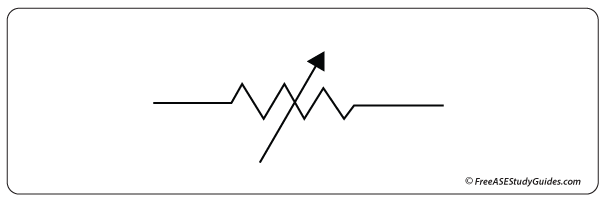
21. A vehicle with an EATC air conditioning system has low fan speed operation during high demand situations, like in direct sunlight. Technician A says this is because something is covering the sun load sensor's photo diode. Technician B says a sun load sensor is a variable resistor and can be tested with an ohmmeter. Who is correct?
22. A gurgling sound is heard coming from inside the dashboard of a vehicle. Technician A says this is air trapped in the heater core. Technician B says this noise can be caused by a blown head gasket. Who is correct?
23. A manifold gauge indicates a system has low discharge pressure. The MOST likely cause of this condition is:
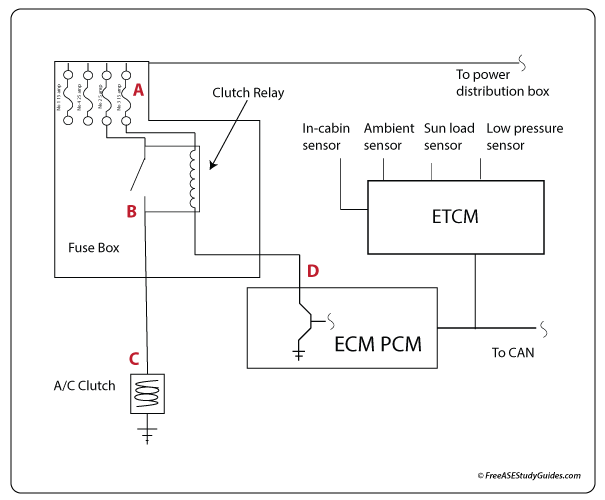
24. There is a short to ground at point D of the electrical diagram above. Which of the following statements is true?
25. The compressor is rapidly cycling on and off on a CCOT air conditioning system. Technician A says this condition can be caused by a low refrigerant charge. Technician B says this could be caused by a faulty clutch cycling switch. Who is correct?
26. Technician A says while recovering 1234yf refrigerant from an automotive air conditioning system the refrigerant must be recovered into a dedicated cylinder, refrigerants cannot be mixed. Technician B says R-1234yf refrigerant is stored in a white container. Who is correct?
27. Technician A says an ambient temperature sensor senses cabin air temperature. Technician B says a faulty ambient temperature sensor can prevent compressor clutch engagement. Who is correct?
28. During an initial inspection, the technician notices that one line on the receiver drier is cooler than the other. This is caused by:
30. Two technicians are discussing refrigerant storage. Technician A says HFC-134a is contained in a sky blue container. Technician B says R-1234yf refrigerant is stored in a white container with a red stripe. Who is correct?
31. During a performance test on a CCOT system the manifold gauge indicates that the high side pressure is low and the low side pressure is high. This is caused by a:
32. An air conditioning system blows only warm air when the heater is on high output. Technician A says this could be a faulty heater control valve. Technician B says this could be caused by the cooling system's thermostat. Who is correct?
33. Technician A says a fixed orifice tube varies the flow of refrigerant in relation to temperature. Technician B says a fixed orifice tube is located between the condenser and the evaporator. Who is correct?
34. Technician A says the expansion valve is located on the inlet port of the evaporator. Technician B says the expansion valve's temperature sensing bulb is located near the outlet port of the evaporator. Who is correct?
35. Technician A says evacuating an air conditioning system will remove air, debris, and moisture. Technician B says to evacuate the system any time it's been exposed to the atmosphere. Who is correct?
36. During a visual inspection an oily spot is found on a hose leading from the compressor. Technician A says there may be a refrigerant leak in the system. Technician B says today's R134a systems use mineral oil. Who is correct?
37. An air conditioning system contains a thermostatic expansion valve. The suction line leading to the compressor is cool to the touch. This indicates:
39. A vehicle has poor air conditioning performance. The customer has added R134a refrigerant to the system. Technician A says to use a refrigerant identifier. Technician B says refrigerant mixtures are not recommended, but will not affect system pressures. Who is correct?
40. An air conditioner with an expansion valve performs poorly only during the hottest times of the day. Technician A says the receiver drier may be saturated. Technician B says there may be moisture in the refrigerant. Who is correct?
Please select an answer