ASE A4 Steering and Suspension Practice Test
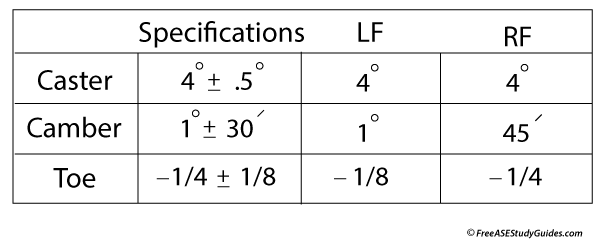
alignment chart 2

41. Technician A says the vehicle in the chart above is within specifications. Technician B says the vehicle's front toe is out of specification. Tire wear will result from this condition. Who is correct?

  • A. Technician A
  • B. Technician B
  • C. Both A and B
  • D. Neither A or B
alignment chart 2

41.

Answer A is correct. Technician A is correct. The vehicle in the chart is within specifications. Notice the different methods of displaying the vehicle's alignment angles.

Answer B is wrong. The toe is within specifications. An alignment technician will try to achieve the preferred angle of -1/4”, and adjust the front toe accordingly.

Answer C is wrong. Technician A is correct.

Answer D is wrong. Technician A is correct.

42. Technician A says worn steering linkage results in loose steering and vehicle wander. Technician B says worn rack bushings can cause changes to the vehicle's toe angle after a wheel alignment. Who is correct?

  • A. Technician A
  • B. Technician B
  • C. Both A and B
  • D. Neither A or B

42.

Answer A is wrong. Loose or worn steering linkage will result in a loose wheel and steering wander.

Answer B is wrong. Loose or worn rack bushings result in excessive rack movement. This movement can change the toe adjustment after hitting a bump or pothole. This issue is also known as bump steer.

Answer C is correct. Both technicians are correct.

Answer D is wrong. Both technicians are correct.

43. There is noticeable wear on the left front tire of a rear-wheel-drive vehicle. The technician suspects the camber angle is out of specification. All these characteristics of camber are true EXCEPT:

  • A. Negative camber causes wear on the tires inside the tread.
  • B. An out-of-specification camber angle will result in a steering pull condition.
  • C. The vehicle will pull to the side with the most positive camber.
  • D. Camber is the forward or rearward tilt of the steering axis viewed from the side of the vehicle.

43.

Answer A is wrong. This is an except question. The tire will wear on the inside tread if the camber is negative.

Answer B is wrong. Out-of-specification camber will result in a pull condition. Inspect the vehicle for a bent control arm, spindle, or strut.

Answer C is wrong. The vehicle will pull to the side with the most positive camber.

Answer D is correct. Caster the forward or rearward tilt of the steering axis viewed from the side of the vehicle.

44. A vehicle makes a clunking sound and pulls to the right when the brakes are applied. During an alignment check, the technician noticed too much negative caster on the right front wheel. Technician A says a seized brake caliper is most likely causing this clunk. Technician B says a worn strut rod bushing is most likely causing this condition. Who is correct?

  • A. Technician A
  • B. Technician B
  • C. Both A and B
  • D. Neither A or B

44.

Answer A is wrong. A seized right front brake caliper will cause the vehicle to pull to the left when braking.

Answer B is correct. Worn strut rod bushings result in a clunking noise when the brake is applied because the lower control arm shifts back from a lack of bushing support. Back and forth movement of the strut rod affects a vehicle's caster angle. Some vehicles use the strut rod to adjust the caster.

Answer C is wrong. Technician B is correct.

Answer D is wrong. Technician B is correct.

45. A front wheel drive passenger car with EPS electric power steering has lost power assist and is hard to steer. The MIL is illuminated and a scan indicates code P0562 System Voltage Low. Which of the following could be the cause?

  • A. Low battery voltage.
  • B. A faulty alternator.
  • C. A faulty electrical connection.
  • D. All of the above.

45.

Answer A is wrong. Low‑voltage abnormalities are most commonly caused by a weak or aging battery.

Answer B is wrong. With the engine running, alternator output should typically measure 13.5–14.5 volts. Any reading outside this range warrants further testing.

Answer C is wrong. Modern vehicles are highly voltage‑dependent, and even brief drops in system voltage can trigger warning indicators, cause modules to reset, or lead to engine stalling.

Answer D is correct. The engine control module sets P0562 System Voltage Low and illuminates the MIL when system voltage falls below its calibrated threshold, typically around 10–11 volts. Control modules on the CAN network depend on stable voltage to operate correctly. As the battery deteriorates or connections develop resistance, modules like the PSCM may behave erratically or shut down entirely.