1.   A vacuum gauge is connected to the
intake manifold of an engine and the
needle fluctuates between (15 and 20 in
Hg) at idle. This reading indicates:

    A.  A Normal Condition.

    B. Late Ignition or Valve Timing.

    C. A Stuck Valve or Misfire.

    D. A Clogged Exhaust.
2.   A cast iron block is cracked.
Technician A says welding is an excepted
method of repairing this engine block.
Technician B says metal pinning is an
accepted method of cracked engine
block repair. Who is correct?

    A. Technician A

    B. Technician B

    C. Both technician A and B

    D. Neither technician A or B
3.   The least likely to cause low oil
pressure in an engine is:

    A. Oil Pressure Valve.

    B. Crankshaft Bearings.

    C. Camshaft Bearings.

    D. Worn Valve Guides.
For more information about ASE, visit the official ASE website at www.ase.com
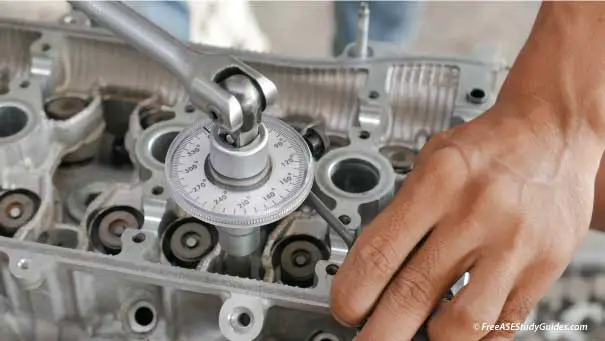
4.   Technician A says that torque to yield
bolts can not be used twice. Technician B
says that torque to yield bolts can be
reused as long as they are cleaned and
re-torqued. Who is correct?

    A. Technician A

    B. Technician B

    C. Both technician A and B

    D. Neither technician A or B
10.   A vehicle has white smoke coming
from its tailpipe. The cause of this
problem is most likely:

    A. Worn Piston Rings.

    B. Blown Head Gasket

    C. Worn Valve Seals

    D. Leaking Fuel Injector
7.   A technician installs a radiator
pressure tester on the radiator of a cold
engine. After starting the engine the
pressure quickly rises to 18 psi.
Technician A says this is a normal
condition. Technician B says the engine
may have a leaking cylinder head gasket.
Who is correct?

    A. Technician A

    B. Technician B

    C. Both technician A and B

    D  Neither technician A or B
6.   Technician A says valve spring
installed height is measured from the
base of the valve spring retainer to the
pocket in the cylinder head. Technician B
says the valve margin will not effect its
operating temperature. Who is correct?

    A. Technician A

    B. Technician B

    C. Both A and B

    D. Neither Technician A or B
8.   Two Technicians are discussing the
PCV system on an engine. Technician A
says a stuck closed PCV valve could
cause engine oil seals to leak.
Technician B says that the PCV system
allows the blow-by gases from the
crankcase to flow into the intake
manifold for recombustion.
Who is correct?

    A. Technician A

    B. Technician B

    C. Both technician A and B

    D. Neither technician A or B
9.   Technician A says that magnetic
particle detection is an acceptable
method to detect cracks in aluminum
castings. Technician B says a special dye
is used to detect cracks in aluminum
castings. Who is correct?

    A. Technician A

    B. Technician B

    C. Both technician A and B

    D. Neither technician A or B
5. The best tool for checking crankshaft
end-play is a:

    A. Bore gauge

    B. Digital micrometer

    C. Dial indicator

    D. None of the above
Free A.S.E. Study Guide
An ASE Study Guide for the Automotive Technician
® All Rights Reserved
© Copyright 2008-2009
A1-Engine Repair
Practice Test