ABS Wheel Speed Sensors
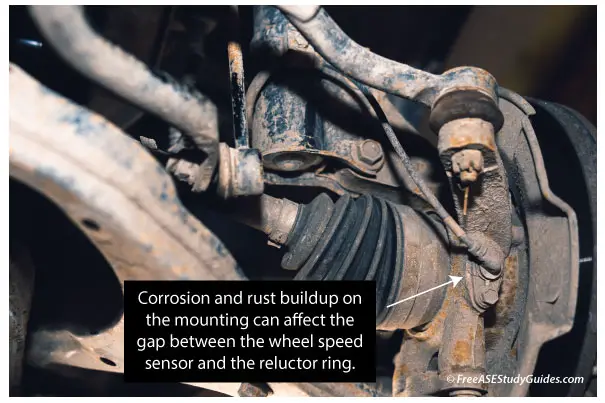
Wheel speed sensors can be either passive or active. They look similar and both types monitor wheel rotational speed. A passive wheel speed sensor generates a small voltage as the toothed tone wheel passes by its tip. The frequency and amplitude of this signal increase as wheel speed increases. The air gap between a passive sensor and the tone ring is critical. Rust buildup on the steering knuckle or mounting surface can increase this gap, leading to erratic and unwanted ABS operation—especially at low speeds.
Low‑amplitude Weak Signal
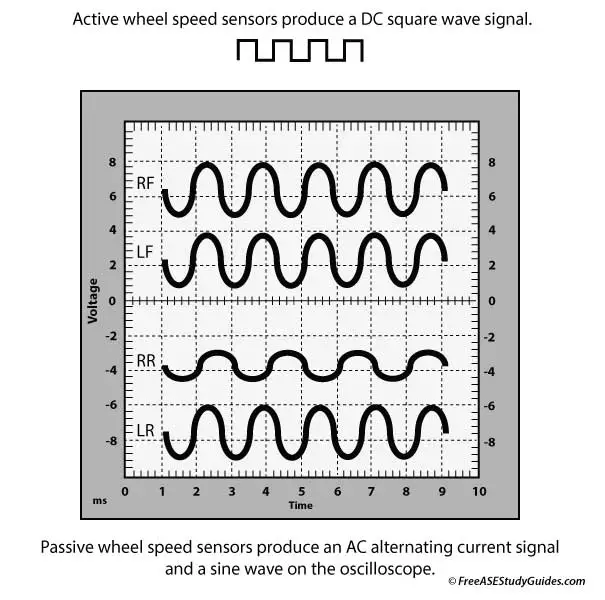
A sensor with an issue such as an excessive air gap will produce a weak, low‑amplitude signal and a distorted waveform when graphed and compared to the others.
Low Speed ABS Activation
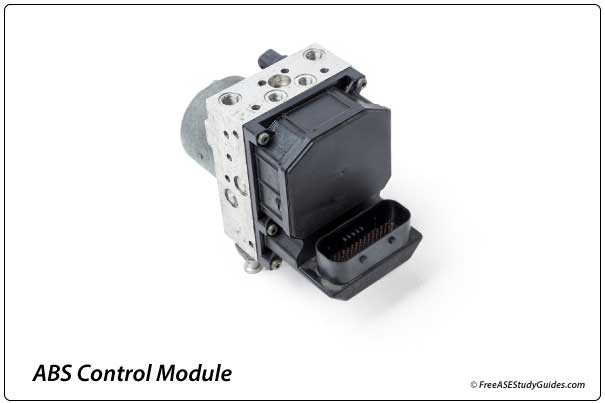
Problems with an ABS wheel speed sensor or its circuit can cause symptoms such as low‑speed ABS activation. Passive wheel speed sensors do not monitor low speeds as effectively as active sensors. Wheel speed sensors are a vital component of ABS systems. When the ABS control module detects a faulty wheel speed sensor, it disables the Anti‑lock Brake System and illuminates the ABS warning light.
Active Wheel Speed Sensors
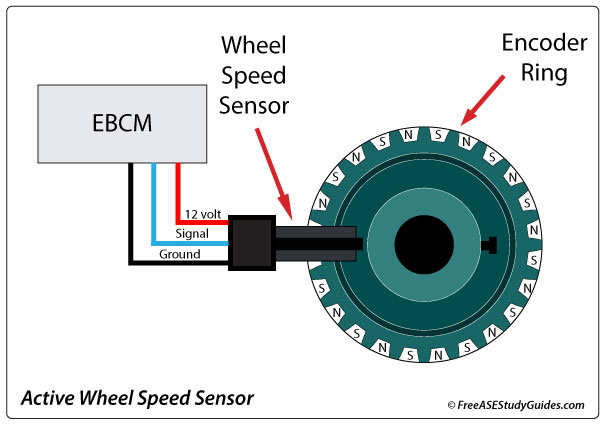
Active wheel speed sensors receive a 12‑volt supply from the control module on one wire and send a changing signal back to the module on the signal wire as the wheel rotates. The encoder ring is typically located inside the hub and contains a multi‑pole magnetic ring with alternating north‑ and south‑poled segments. These sensors are critical components in vehicles equipped with Advanced Driver‑Assistance Systems (ADAS), as they can register speeds down to 0 mph and detect when the vehicle is moving in reverse. Active wheel speed sensors are also essential to Traction Control and Stability Control systems.
Passive Wheel Speed Sensors
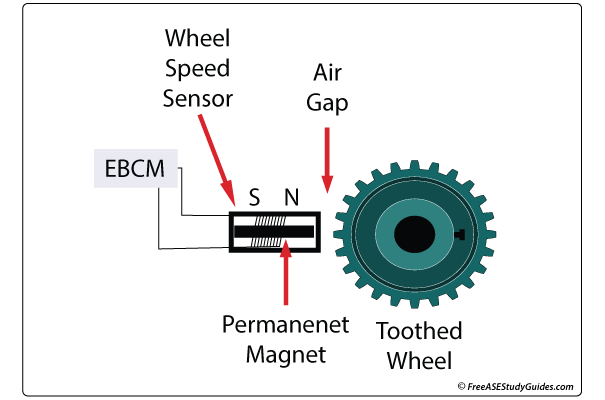
Passive wheel speed sensors are common and often found on older vehicles. They produce an AC (alternating current) signal that appears as a sine wave on an oscilloscope. Active wheel speed sensors, by contrast, are very different and generate a DC square‑wave signal. Active wheel speed sensors are typically installed on all four wheels of most modern vehicles.
Wheel Speed Sensor Circuit

For a brief moment before the vehicle starts, the control module performs a circuit check by sending a voltage signal to each wheel speed sensor and monitoring the return signal. If it detects any short or open circuit, the ABS warning light is illuminated.
Passive sensors are magnetic, so metal debris can accumulate on the sensor tip, and the reluctor wheel can become damaged or packed with dirt or clay. If a scan tool indicates a fault in one of the wheel speed sensors, inspect the wiring, the sensor tip, and the reluctor ring for contamination or physical damage.