Front End Alignment: Toe Adjustment

In the illustration, the toe angle is represented by an imaginary line drawn down the center of the tire and another imaginary line down the vehicle's center. If the tire is toed in, the two imaginary lines intersect. If the tire is toed out, the line angles away from the vehicle's center.
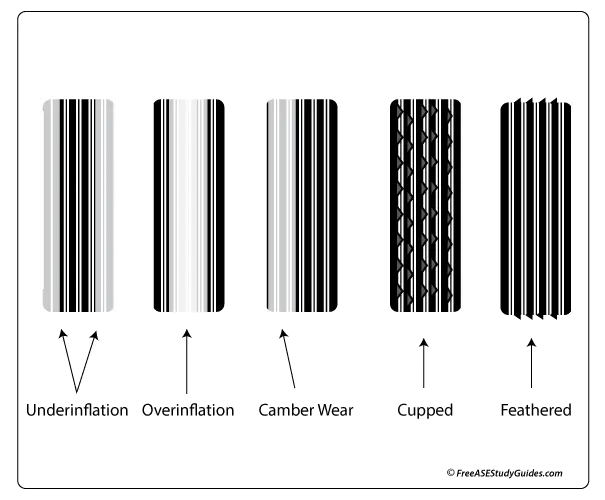
Incorrect toe settings can result in significant tire wear. It causes diagonal scuffing and feathering of the tire's tread. Check this by running your open hand across the tread of each tire, checking for tire feathering, cupping, and unusual wear.

Adjust the toe by turning the inner tie rod on a rack and pinion steering system and by turning the adjusting sleeve on a parallelogram linkage system.

To adjust the toe on a vehicle with a typical rack and pinion system, loosen the nut on the inner tie rod about a half-inch from the outer tie rod end. Loosen the clamp holding the bellows boot and make sure the boot is free (not sticking) to the inner tie rod. Rotate the inner tie rod.
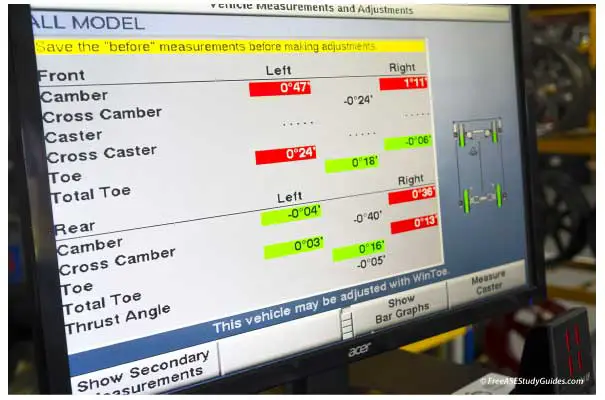
Always lock the steering wheel with a wheel lock correctly wedged between the seat and the wheel. Typically, a technician turns each inner tie rod one-half of the total toe specifications and splits the toe between the two tires.