A/C Clutch Relay
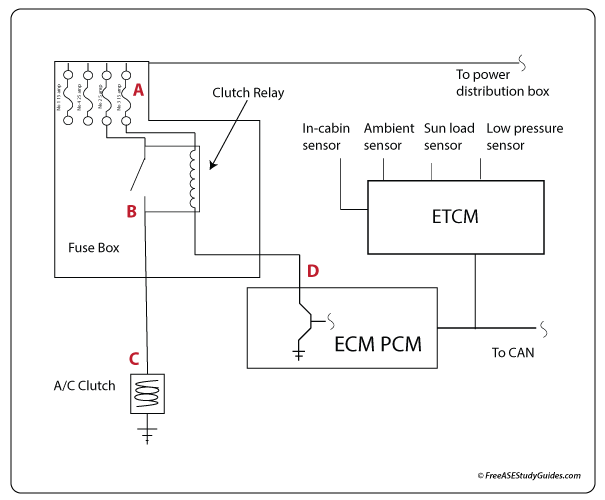
The air conditioning electronic control module can control a high-current component like the compressor clutch by applying a low current to the circuit's relay.

Electromechanical relays use a coil that controls contacts or an arm that swings between two contacts. When the relay is open, the compressor's clutch is disengaged; when the ECU powers the relay' coil, the contacts close, completing the circuit and applying the compressor clutch.
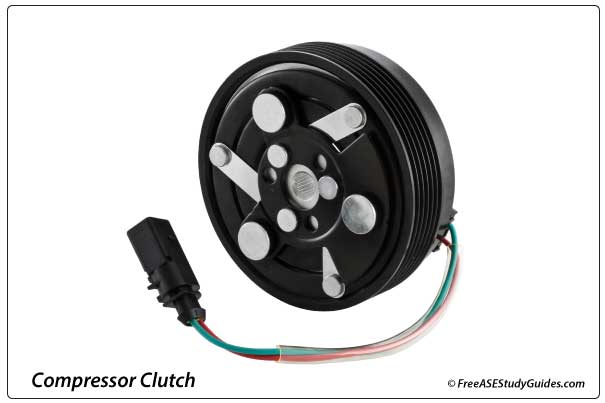
Below is a common (SPST) single-pole, single-through relay. A magnetic field draws the relay's arm toward the high-current circuit as low current passes through the coil. The compressor's clutch receives power and engages when the two contacts connect.
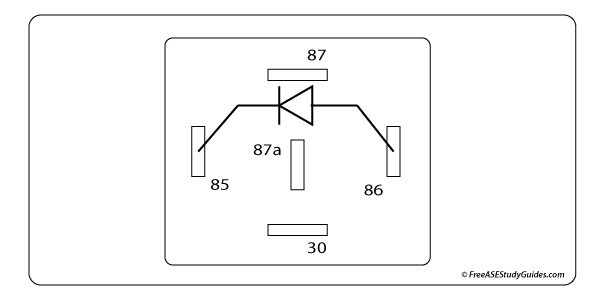
A standard has been developed for the plug of a mechanical relay. The relay uses numbers 85 and 86 as the electromagnet control. This coil usually contains a diode to protect the contacts and other circuits from the sudden current collapse when switched off. It's important not to reverse the 85 and 86 (coil) pins on some of these circuits. The number 30 pin is connected to the high current source, and number 87a is the prong where the arm parks (off). The 87 pin activates the device (on).
Diagnosing a Sticking Relay
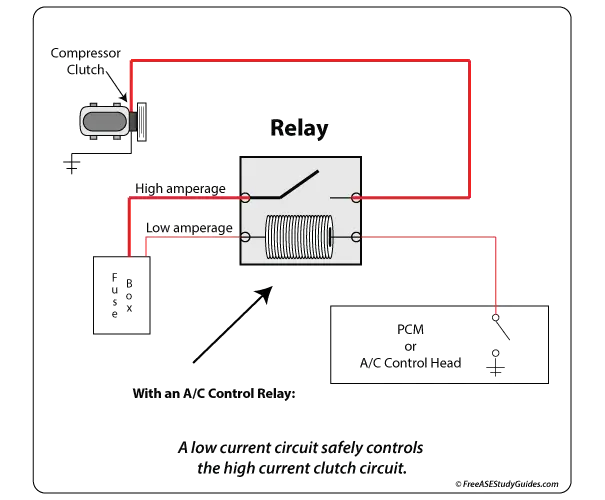
When a relay sticks closed, the compressor's clutch will stay engaged continuously. When the relay fails or sticks open, the compressor's clutch will not engage; this is common.
